

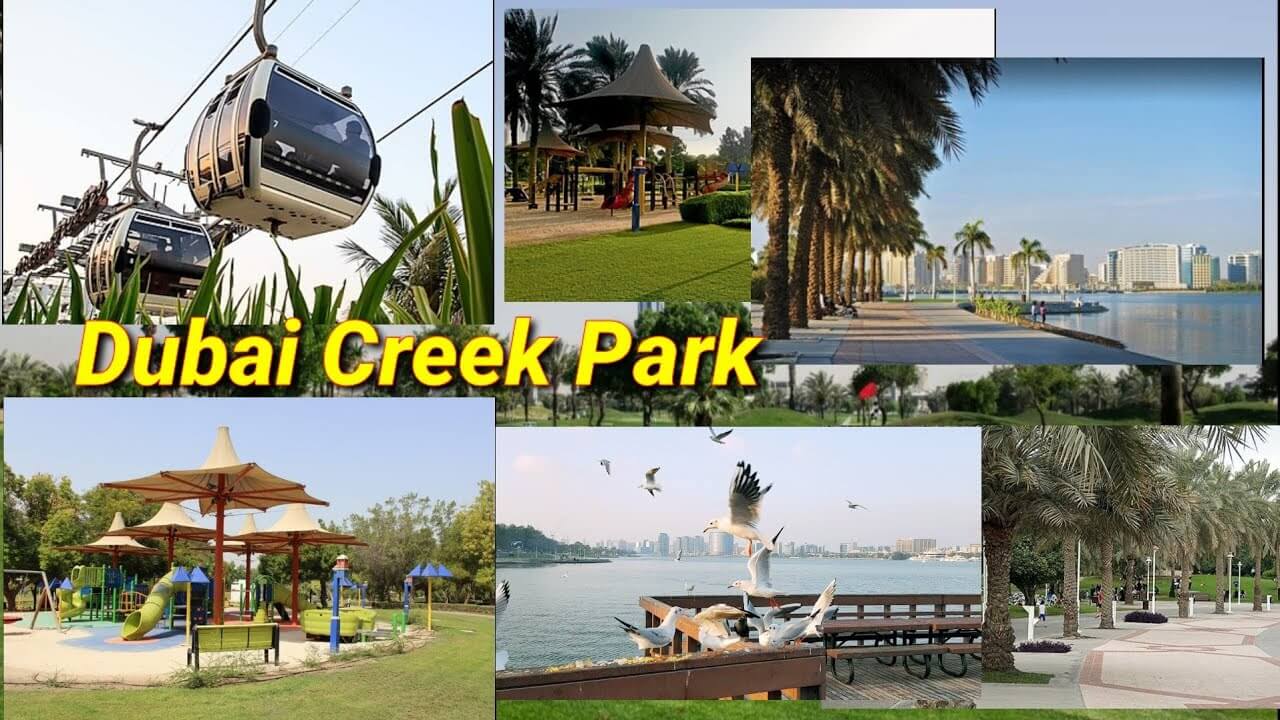
Dubai Creek Park runs for roughly 2.6 kilometres along the Bur Dubai side of the Creek, between the Maktoum Bridge and the Garhoud Bridge. At 96 hectares it is one of the largest green spaces in the city, and it packs a surprising range into that stretch, a cable car, a dolphinarium, an indoor children’s science centre, a mini train, bike rental, barbecue terraces and long stretches of waterfront where the main activity is simply sitting and looking across the water.
Entry is AED 5 per person. Children aged two and under enter free. That fee gets you into the park itself, the lawns, the waterfront, the paths, the seating and the barbecue stations. Every named activity below is a separate paid attraction with its own ticket, so the realistic cost of a visit depends heavily on how many of them you plan to do.
Table of Contents
Arrival & Entrance
Creek Park is in Umm Hurair 2, on the Bur Dubai side of the Creek. There is no direct Metro station at the park. Dubai Healthcare City Metro Station is the nearest stop, roughly half a kilometre away, which is manageable in cooler weather but less comfortable in the summer heat. Al Jaddaf Metro Station is also within reach but involves a longer walk or a short taxi ride.
The main entrance from Garhoud Bridge is one option, but Gate 1 is the better choice if you are heading to the cable car, the Dolphinarium or Children’s City. Gate 1 has a broad curved canopy over a row of stainless-steel waist-high barriers, with bilingual signage and illuminated green arrow indicators on several barrier units. A yellow tactile paving strip crosses the foreground and leads toward the wider left-hand lane.
Inside the park, a multi-arm green fingerpost stands near the internal vehicle area beside a marine-animal sculpture and advertising boards. The fingerpost points toward different routes and facilities, though the specific destinations are not always easy to read from a distance. The landmarks that actually help with orientation are Gate 1 itself, the marine-animal sculpture, a large white ribbed wing- or sail-like sculpture on a sandy waterside mound, and a dark looped abstract sculpture on a separate raised lawn.
If you are driving, the parking areas sit close to the gates. If you are taking a taxi, Gate 1 is the simplest drop-off point for the main paid attractions. If you are walking from the Creek Metro Station, allow extra time and stick to the shaded routes where possible.
Once inside, the park unfolds as a mix of open lawns, curving paths, waterfront promenade and raised terraces. The paths fork and cross, the surfaces change, and the waterfront shifts between distinct characters. In some sections, you approach the water from the lawn across a kerbed grey paved route, a pink-toned pedestrian strip and low clipped planting before reaching a segmented low concrete edge, with a broad pale sand shore strip curving beside the water.
In other sections, a dark slatted railing runs along a deck-like surface, with fixed-looking picnic tables positioned between the paved route and the railing. One location has a short railed projection into the water, with a separate line of pale posts continuing into the water nearby. There is no single correct route. The park rewards wandering more than following a fixed circuit.
Dubai Creek Park Activities
The park is not a single circuit with a fixed sequence. It is a collection of separate paid experiences and free facilities spread across a long, uneven site. Some suit families with young children, some suit couples, and some exist mainly for anyone who wants a bench facing the water. Treat the eight activities below as options to combine rather than a checklist to complete.
1. Ride on the Cable Car
The cable car is the park’s most recognisable paid activity. It lifts you roughly 30 metres above ground and runs for about 2.3 kilometres along the Creek, giving you a view over the treetops, the lawns and the water. A full loop takes around 30 minutes. Adult tickets typically sit around AED 25, with a lower rate for children, though the fare has changed over the years and is worth confirming at the ticket point before you queue.
The important point is that the cable car is a slow elevated loop, not a transport service. You get off at the same place you started. If your time in the park is limited, or you have already walked the waterfront promenade, the ground-level view is still good — the cable car adds height and a different angle rather than access to a part of the park you cannot otherwise reach. It is best treated as a 30-minute overview early in the visit, before you decide where to spend the rest of your time.
2. Shop Till You Drop
Shopping inside Creek Park is limited to small kiosks and stalls rather than any kind of retail destination. A small red-and-white striped kiosk with an open display face stands among palms beside one of the broad paved routes. A colourful merchandise stall with hanging goods and stocked display walls sometimes operates beside the cart starting area. A curved stone-faced building with a lit doorway and a long lit opening faces the paved waterfront area.
What is on sale is mostly snacks, drinks, ice cream and a narrow range of convenience items. Prices are higher than outside the park, and several visitors note that it is better to bring your own food and drink for a long stay.
3. Enjoy the Atmosphere with a Bike Ride
Bicycle rental is available inside the park, with a mix of single bikes and larger multi-person cycles built for two or four riders. Rental typically starts around AED 50 for a basic bicycle and rises for the larger options. Hiring is by time slot rather than by distance, so the value depends on how much of the park you actually cover.
The park’s internal paths are wide enough for cycling, and the waterfront promenade gives you a flat, continuous route with open views across the Creek. The surface changes several times along the way: grass, smooth pale paths, grey interlocking paving, pink-toned promenade paving, darker deck surfaces, raised stone-capped terraces and pale shore material all appear across the site. Curbs sit beside the roadway and promenade in several locations, and the paths fork and cross rather than running as a single straight promenade. If you are cycling with children, the open lawns and quieter internal routes are easier to manage than the busier sections near the gates. If you are on a multi-person cycle, plan your turns earlier than you would on a single bike, because the wider frame handles the surface transitions less comfortably.
4. Eat to Your Heart’s Content
Food inside the park comes from three sources, the kiosks and stalls, the cafés attached to the paid attractions, and the barbecue areas where you cook your own food. The barbecue option is the most economical for a group and the one most local families use.
Designated barbecue areas are spread across the park with grill stations set up for public use. You supply the meat, vegetables, charcoal and tools. The raised terrace is a good example of how these work in practice. A curved stone retaining wall with a broad dark cap encloses an elevated paved terrace above the lower lawn. The wall cap doubles as a work surface beside the grills, with space for a mesh rack, utensils, a board and small containers. At least two rectangular metal grill boxes can sit together on the cap. Backed benches and two large bin-like receptacles sit on the paved terrace, and folding chairs, bags and food containers are commonly arranged near the grills. A circular recessed feature filled with large pale rocks occupies the centre of the terrace and breaks up the circulation, so you may need to walk around it depending on where you set up.
The trade-off is between the raised terrace and the lower lawn. The terrace gives you a defined cooking area, seating and a slight elevation over the park, but it is separated from the lower path and can feel enclosed. The lawn is more open and closer to the waterfront, but it does not have confirmed cooking provision in the same way. If you plan to grill, the designated areas are the safe choice, and arriving early on weekends matters because the better spots fill quickly.
If you are not cooking, the kiosk food is limited in range. Several visitors recommend bringing your own food and drink from outside, partly for choice and partly for cost. There is no shortage of places to sit and eat what you bring — benches recur on the waterfront-facing lawn, beside internal paths, around the raised terrace, and along the evening-lit routes. A broad paved plaza at one end of the park has picnic-table-style furniture with attached seats on a wide paved area with trees and lamp posts, providing group seating away from the rail-enclosed waterfront deck.
5. Ride a Mini Train
A mini train runs a circuit around the park. It is a slow, open-sided ride that covers more ground than you would manage on foot in the same time, and it is popular with younger children. The train is a separate paid activity, not included in the AED 5 park entry.
The train is most useful as an orientation tool early in the visit, or as a way to rest tired legs without cutting the trip short. It is not a thrill ride. The pace is gentle, the route follows the park’s perimeter and internal paths, and boarding points are marked along the way. If you are travelling with a pushchair or a wheelchair, check access at the boarding point before you commit, because the boarding platforms are not uniform across the route.
6. Dubai Dolphinarium
The Dubai Dolphinarium sits inside Creek Park at Gate 1, on Umm Hurair Road. It hosts a dolphin and seal presentation, which the venue describes as the first and only of its kind in the UAE, and a separate exotic bird presentation. Shows run daily except Tuesdays. Dolphin and seal shows are at 2pm and 6pm. Bird shows are at 3.15pm and 7.15pm.
The Dolphinarium ticket does not include park entry. You still pay the AED 5 park fee at the gate, and the Dolphinarium requires its own ticket. Prices are typically around AED 112 for adults and AED 62 for children, though the rate can vary by show time and booking channel. The show lasts about an hour. The venue is indoors and air-conditioned, which makes it a practical option during the hotter months when the outdoor sections of the park are uncomfortable.
Two planning points matter here. First, the Tuesday closure and the fixed show slots limit your flexibility — if you are travelling specifically for the dolphin show, check the schedule before you set out. Second, the Dolphinarium sits in the same Gate 1 area as Children’s City, so the two can be combined in a single visit, but each requires its own ticket and neither includes the park entry fee.
7. Make the Best of the Barbecue Spots
The barbecue areas are one of the park’s defining features and one of the main reasons local families return. Multiple designated spots across the park have grill stations, and they are free to use once you have paid the park entry fee. You supply the food, the charcoal and the utensils.
The practical detail that matters is the layout of the terrace areas. The raised terrace, with its curved stone retaining wall and broad dark cap, is set above the lower lawn and winding paths. The cap runs continuously and gives you a working surface beside the grill boxes. Backed benches sit around the paved terrace, bins sit nearby, and the rock-filled circular feature in the centre means the usable cooking space is arranged around a central obstacle rather than in one open line. If you are cooking for a group, arrive early enough to claim a stretch of the wall cap, because the usable grill space is finite and the terrace fills quickly on weekends and public holidays.
The trade-off between the terrace and the lower lawn is real. The terrace gives you a defined cooking area, seating and elevation over the park. The lawn is more open and closer to the waterfront. The terrace is also separated from the lower path by the retaining wall, which matters if you are carrying equipment back and forth. If you plan to grill, the designated areas are the safe choice. Barbecue is not permitted outside these areas.
8. Children’s City
Children’s City is an indoor educational and entertainment centre inside Creek Park, aimed at children roughly between two and fifteen years old. It is a separate paid attraction with its own ticket, typically around AED 15 for adults and AED 10 for children, though the rate has changed over time and is worth confirming at the door.
The centre contains interactive exhibits covering science, space, nature, the human body and local heritage, along with a library, a theatre and dedicated play areas. The format is hands-on rather than display-only, so children move between short activities instead of following one long presentation. It is fully indoors and air-conditioned, which makes it the practical option when the heat or the weather rules out outdoor activity.
Children’s City shares the Gate 1 entrance area with the Dubai Dolphinarium. Both require separate tickets and neither includes the AED 5 park entry fee. If you are planning to do both in one visit, budget for the park entry, the dolphin show and the Children’s City ticket, and check the Dolphinarium’s Tuesday closure before you commit to a day.
Dubai Creek Park Timings
Park timings vary by day and season. On weekdays, the park generally opens at 8am and closes at 10pm. On weekends, closing extends to 11pm. During Ramadan, Dubai Municipality has extended Creek Park hours in recent years, with the park staying open until midnight. Summer timings can also shift, with a shorter afternoon-to-evening window during the hottest months.
The paid attractions keep their own hours. The Dubai Dolphinarium operates daily except Tuesdays, with fixed show times at 2pm, 6pm, 3.15pm and 7.15pm. Children’s City has its own schedule, which has historically included shorter hours on Sundays. The cable car, mini train and bike rental operate within the park’s general opening hours but can close earlier or pause during maintenance.
Check the park’s official page or call ahead if you are travelling specifically for one of the paid activities. The park itself is reliably open from morning to late evening. The individual attractions are where the timing differences matter.
Dubai Creek Park Entrance Fee
Entry to Creek Park costs AED 5 per person. Children aged two and under enter free. The fee is paid at the gate, and there are multiple gates, including Gate 1 near the Dolphinarium and Children’s City, and Gate 4 on the other side of the park.
The AED 5 fee covers the park itself, the lawns, the waterfront, the paths, the seating areas, the playgrounds and the barbecue stations. It does not cover the cable car, the mini train, the bike rental, the Dubai Dolphinarium or Children’s City. Each of those is a separate paid activity with its own pricing.
People of determination enter free, and the park has accessible attractions. Parking is available and has historically been free, though it fills up on weekends and during peak times.
The realistic cost of a visit depends on what you plan to do. A picnic on the lawn with your own food costs AED 5 per person. Adding the cable car, a bike ride and a dolphin show moves the cost into the range of AED 150 or more per adult. The entrance fee is low, but it is only the entry point to a set of separately priced activities.
Practical Points for Planning Your Visit
The park is busiest on weekends and public holidays, particularly in the late afternoon and early evening. Weekday mornings are quieter, and the waterfront benches and barbecue spots are easier to secure. During Ramadan, the park stays open later and the atmosphere changes, with more families arriving after sunset.
Heat is the main constraint for most of the year. The park has mature trees and several open-sided roofed shelters with pitched roofs beside the lawn and waterfront routes, but large sections of the waterfront and lawns are exposed. Between May and September, plan around early morning or late afternoon and evening. The indoor attractions — Children’s City and the Dolphinarium — are the practical options during the middle of the day.
Seating is spread throughout. Backed benches face the waterfront and sit beside internal paths, around the raised terrace and along the evening route. Benches on the waterfront-facing lawn have their backs to the lawn and face the road and water direction. Terrace benches sit around the paved terrace and the rock-filled centre. Waterfront table-and-bench units sit immediately inside the railing. A broad paved plaza at one end of the park has picnic-table-style furniture with attached seats on a wide paved area with trees and lamp posts.
Bins are positioned beside paths and seating throughout the park — near waterfront benches, on the raised terrace, along internal paths and beside benches in various sections. Toilets are available, though their exact locations are not always obvious from the main routes, so note where they are when you arrive.
The play areas sit beneath large tensile canopies supported by coloured poles, with swing-frame equipment and other play elements beneath several large peaked fabric canopies. Backed benches, bins and a paved route appear in the same area, so accompanying adults have somewhere to stop nearby.
Wildlife is present but not guaranteed. A male peacock with a blue neck and a long green tail train has been recorded standing and moving on the short grass beside dense shrubs. This is a recorded sighting rather than a resident population, so treat any wildlife encounter as a bonus rather than a planned part of the visit.
In the evening, tall pole lamps illuminate the waterfront promenade and the main internal routes, and short bollard lights mark the lawn-path edges around curves and forks. The lighting is not uniform. Some sections are clearly lit, while tree-lined intervals between lamps are substantially darker. If you are walking after sunset, stick to the lit routes and avoid the darker stretches if you are unfamiliar with the layout.
The park’s size is the main thing to plan around. At 96 hectares and roughly 2.6 kilometres long, walking from one end to the other and back is a substantial distance, especially in the heat. The mini train, the bike rental and the cable car each reduce the ground you cover on foot, but each is a separate cost. If you are visiting with young children or older visitors, decide in advance which part of the park you want to focus on rather than trying to see everything in one trip.
The park does not permit alcohol or pork on site, and barbecue is allowed only in the designated areas. The park is family-oriented in both layout and rules, and the activities reflect that. A reader who has already skimmed the obvious introductory material should come away from this with a clearer sense of which activities are worth combining, which ones cost what, and where the practical friction sits — the Tuesday Dolphinarium closure, the finite grill space on the terrace, the uneven evening lighting, and the distance between the two main ends of the park.