

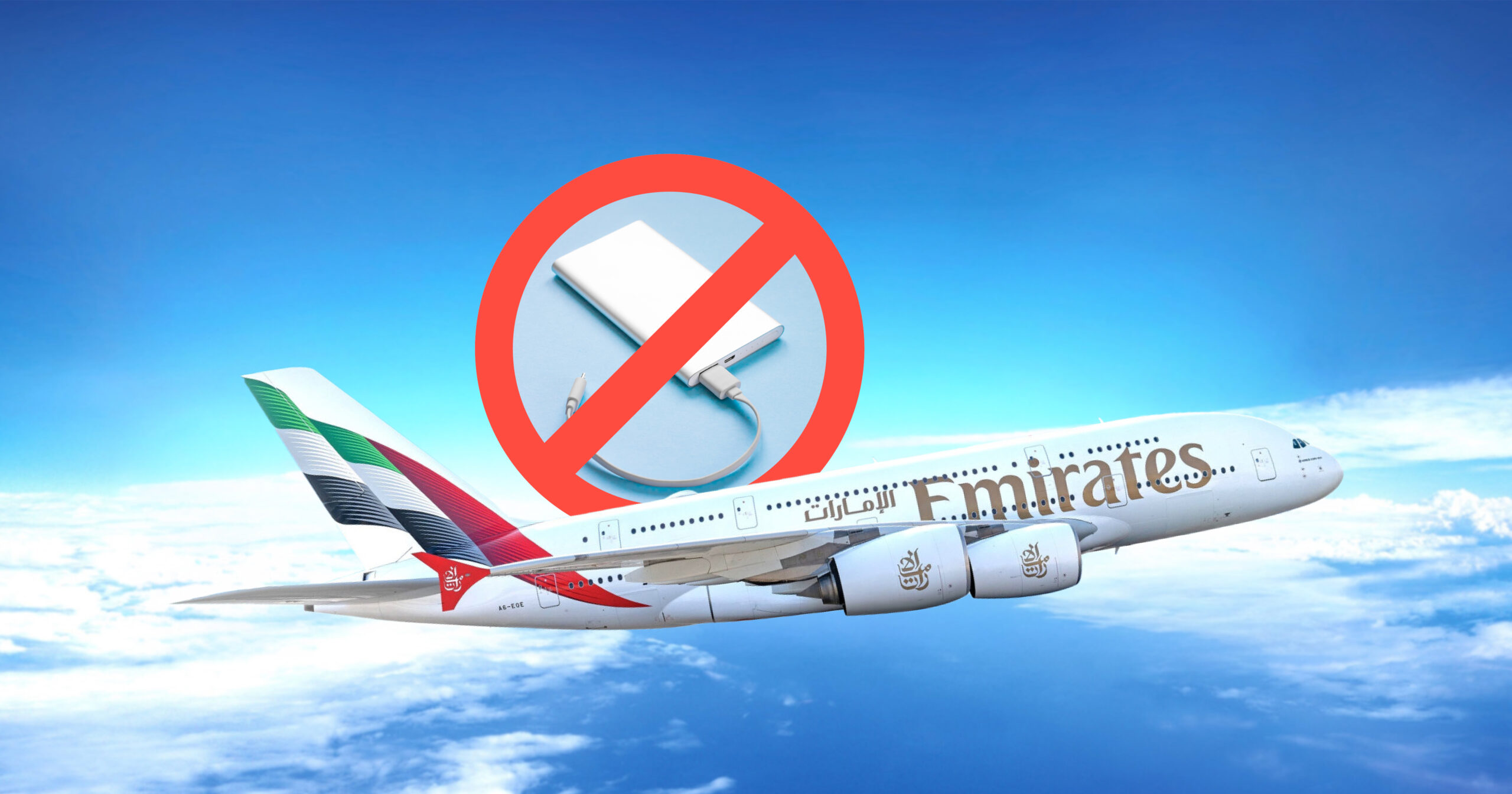
Effective 1 October 2025, Emirates Airlines fundamentally changed how passengers interact with portable chargers during flights. You can still carry one power bank onboard under strict conditions, but you cannot use it at any point during your journey. This guide covers every rule, requirement, and practical workaround you need before your next Emirates flight. From capacity limits to storage locations and what other UAE airlines are doing, consider this your definitive handbook for navigating the Emirates power bank ban with zero confusion at the airport.
Table of Contents
From Allowed to Restricted: What Emirates Changed
What Exactly Is a Power Bank Under Emirates’ Rules?
A power bank is any portable, rechargeable battery device designed primarily to charge other electronic devices. Emirates’ official definition covers smartphones, tablets, laptops, and cameras as the primary devices these power banks serve . The ban applies to all brands, sizes, and types of power banks without exception. Even premium power banks with built-in cables or wireless charging capabilities fall under the same restrictions. The key distinction is that Emirates has not banned possession—only usage and storage in specific locations. You may still bring a compliant power bank onboard, but it must remain dormant throughout the flight. This definition also includes “smart” power banks with digital displays and multi-port charging hubs.
Why Did Emirates Ban Power Bank Usage? The Lithium Battery Risk
Lithium-ion batteries, which power nearly all portable chargers, pose a unique fire hazard in aircraft cabins. When these batteries overheat—a condition called “thermal runaway”—they can ignite spontaneously and produce their own oxygen, making fires difficult to extinguish at 35,000 feet . Emirates implemented this ban following a comprehensive safety review, citing a “significant growth in customers using power banks in recent years” that led to more lithium battery-related incidents across the aviation industry . According to the UAE’s General Civil Aviation Authority (GCAA), these steps align with global standards to prevent rare but dangerous overheating events during flight .
The Six Rules You Must Follow on Every Emirates Flight
One Power Bank Only: Capacity Limits That Matter
Emirates permits exactly one power bank per passenger with a maximum capacity of 100 Watt Hours (Wh). This is approximately equivalent to 27,000 mAh, which covers most standard portable chargers on the market . The device must clearly display its capacity rating—either in Wh or mAh—directly on the product casing. If your power bank lacks visible capacity information, Emirates may refuse to carry it onboard. Power banks exceeding 100Wh are strictly prohibited in all cabin baggage. For context:
- Typical smartphone power bank: 20Wh to 50Wh (5,000–13,500 mAh) – Allowed
- Large tablet power bank: 50Wh to 80Wh (13,500–21,600 mAh) – Allowed
- Laptop power bank: 80Wh to 96Wh (21,600–26,000 mAh) – Allowed up to 100Wh
- High-capacity power bank: 100Wh+ (27,000 mAh+) – Banned completely
Where to Store Your Power Bank During the Flight
Power banks must remain in your immediate reach throughout the flight. Emirates airlines explicitly prohibits placing power banks in overhead stowage bins . Instead, you must store your power bank in one of two locations:
- The seat pocket directly in front of you
- A bag placed under the seat in front of you
This rule allows cabin crew to access the device quickly if a thermal event occurs. The same logic explains why power banks are banned from checked luggage entirely—a fire in the cargo hold cannot be reached during flight . A power bank that remains accessible can be contained or submerged in water by trained crew members. Never pack your power bank in a suitcase or carry-on bag that will go into the overhead bin, and double-check that checked bags contain zero power banks before handing them to airport staff.
Emirates’ Power Bank Rules at a Glance
Below is a complete summary of Emirates’ six power bank regulations. Print this table or save it to your phone before traveling.
| Rule Category | Requirement | Status |
|---|---|---|
| Quantity | One power bank per passenger | Must follow |
| Capacity | Under 100 Wh (≈27,000 mAh) | Must follow |
| In-flight use | Cannot charge devices from power bank | Prohibited |
| Recharging | Cannot charge power bank from aircraft outlets | Prohibited |
| Storage | Seat pocket or under-seat bag only | Prohibited in overhead bins |
| Checked luggage | Zero power banks permitted | Banned completely |
| Capacity labeling | Wh or mAh rating must be visible on device | Required |
Pro tip: If your power bank’s label has worn off, consider purchasing a new one before your trip. Without visible capacity information, airport security may confiscate the device regardless of its actual size.
Other UAE Airlines Are Following Emirates’ Lead
Flydubai’s Power Bank Policy Compared
Flydubai introduced nearly identical restrictions effective the same date as Emirates: 1 October 2025 . Passengers may carry one power bank under 100Wh in hand luggage only. Usage during flight is completely prohibited—this means no charging devices from the power bank and no recharging the power bank from aircraft power sockets. However, Flydubai adds two unique requirements not found in Emirates’ policy:
Pros of Flydubai’s policy:
- Requires power banks to remain switched off throughout the flight
- Recommends storing devices in original packaging or protective pouches to prevent short circuits
- Applies same restrictions to laptops, e-cigarettes, and digital cameras
Cons compared to Emirates:
- No published information on fines or enforcement procedures
- Less explicit guidance on connecting flight scenarios
Flydubai also requires that all lithium-powered devices—not just power banks—be protected from accidental activation during flight .
Etihad, Air Arabia, and Connecting Flights Compared
For travelers connecting to other UAE airlines, here is how each major carrier compares to Emirates :
| Airline | Power Bank Allowed? | Capacity Limit | Usage Allowed? | Storage Requirement |
|---|---|---|---|---|
| Emirates | Yes (one only) | 100Wh max | No | Seat pocket or under-seat |
| Etihad Airways | Yes | 100Wh (100-160Wh with approval) | No | Individually wrapped or protected |
| Flydubai | Yes (one only) | 100Wh max | No | Under-seat; must be switched off |
| Air Arabia | Yes | Subject to approval | Unspecified | Hand luggage only |
Important for connecting flights: If your itinerary includes multiple airlines, you must comply with the strictest policy among them. For example, an Emirates flight followed by an Etihad flight means following Emirates’ one-power-bank limit. International carriers like Singapore Airlines, Qatar Airways, and Air India have also enforced similar restrictions over the past year, so check each airline individually .
Before You Fly: Practical Preparation for 2026
How to Find Your Power Bank’s Watt Hour Rating?
Most power banks display capacity in milliamp hours (mAh) rather than Watt hours. To convert mAh to Wh, use this formula: Wh = (mAh × Voltage) ÷ 1000. Standard power banks operate at 3.7V, making the calculation straightforward. For example, a 20,000 mAh power bank at 3.7V equals 74Wh—well under Emirates’ 100Wh limit . If your power bank displays only mAh:
- 10,000 mAh = 37Wh (allowed)
- 20,000 mAh = 74Wh (allowed)
- 27,000 mAh = 99.9Wh (allowed, just under limit)
- 30,000 mAh = 111Wh (banned)
If the label is faded or missing entirely, consider the device non-compliant. Emirates security staff may ask to see the rating during boarding, especially on flights departing from Dubai International Airport (DXB) . When in doubt, purchase a new power bank with clearly printed specifications before your trip.
What Happens If You Break the Power Bank Rules?
Emirates has not published specific fine amounts for power bank violations, but industry standards and airport security protocols provide clear guidance. If you place a power bank in checked luggage, airport screening will detect it during baggage inspection. The item will be confiscated, and you may face delays while your bag is located and opened . At major hubs like Dubai International, security teams reportedly confiscate thousands of prohibited battery items daily during peak travel seasons . Based on UK and EU aviation enforcement, penalties for carrying prohibited batteries range from £100 to £1,000 (approximately 475 to 4,750 AED), depending on the item and airport . If you use a power bank during an Emirates flight after the ban, cabin crew will instruct you to stop immediately. Repeated violations could result in written warnings or, in extreme cases, being met by airport security upon landing. Emirates emphasizes that these rules “significantly reduce risks associated with power banks,” and enforcement prioritizes passenger safety over punitive measures .
Pre-Flight Checklist for Emirates Passengers
Use this checklist before leaving for the airport to ensure full compliance with Emirates’ power bank rules:
Before Packing:
- Verify your power bank capacity is under 100Wh (or 27,000 mAh)
- Check that capacity rating is clearly visible and legible on the device
- Charge all personal devices (phone, tablet, laptop) to 100% before leaving home
- If you own multiple power banks, select only one to bring
- Remove any power banks from checked luggage immediately
During Packing:
- Place your single power bank in your personal bag (not checked luggage)
- Keep the power bank accessible—not buried under other items
- Do not place the power bank in any bag destined for overhead bins
- For connecting flights, review each airline’s policy separately
Be prepared to show your power bank’s capacity label if asked
At the Airport:
- On long-haul flights, rely on Emirates’ in-seat charging ports instead
- Remember you cannot use the power bank at any point after boarding
- Use airport charging stations to top up devices before boarding